
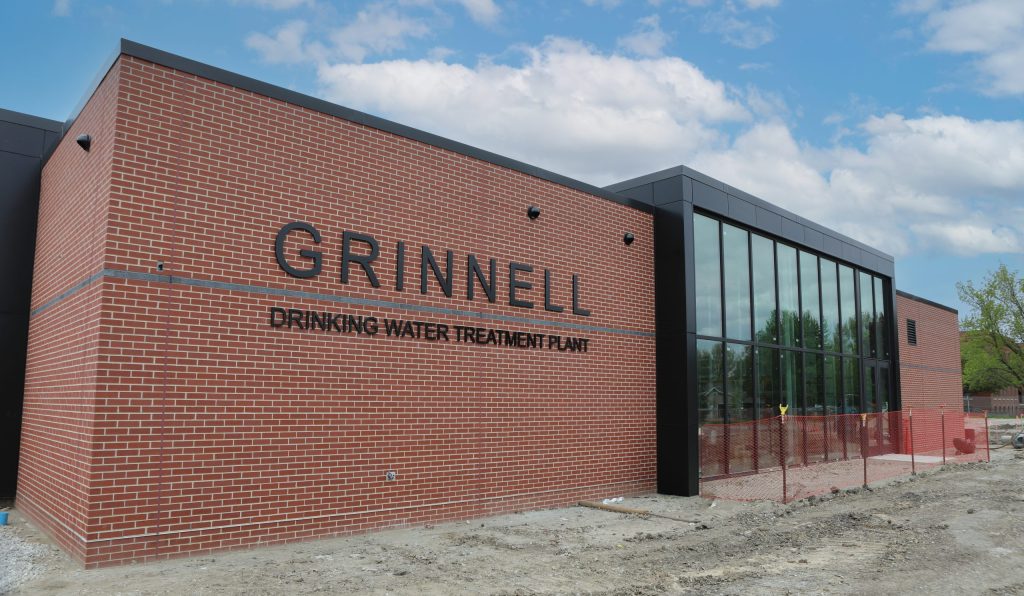
As communities grow and water quality requirements evolve, utilities are increasingly turning to membrane treatment technologies to deliver reliable, high-quality drinking water. Membrane treatment systems provide an effective solution for removing contaminants while helping municipalities meet current demands and prepare for future growth.
The City of Grinnell, Iowa, recently invested in a new water treatment facility centered around membrane treatment technology, demonstrating how modern filtration systems can improve water quality, increase production capacity, and support long-term community needs.
Project Overview: Grinnell’s New Membrane Treatment Facility
The City of Grinnell identified the need for significant water treatment improvements as water demands increased and the existing treatment plant approached the end of its useful life. To address these challenges, McClure provided planning, design, and construction services for a new 11,400-square-foot Direct Membrane Softening Water Treatment Plant.
The facility includes:
- Three nanofiltration treatment trains
- Chemical feed systems
- High service pumping
- A 300,000-gallon prestressed concrete clear well for finished water storage
- Administrative and operational support spaces
Upon completion, the plant is capable of producing 2.13 million gallons per day (MGD) of finished water, with the ability to expand to 2.6 MGD as future demand increases.
Unlike many treatment systems that require extensive pretreatment, the Grinnell facility utilizes direct membrane treatment of water from the Jordan Aquifer, creating an efficient and streamlined treatment process.
Understanding Membrane Treatment
Membrane treatment is a process that uses a semi-permeable membrane to remove unwanted substances from water. Depending on the application, membrane systems can remove particles, microorganisms, dissolved minerals, and other contaminants that affect water quality.
Several membrane technologies are available, including:
- Microfiltration
- Ultrafiltration
- Nanofiltration
- Reverse osmosis
The Grinnell project utilizes nanofiltration membrane treatment, which provides effective removal of hardness and other dissolved constituents while producing high-quality drinking water for the community.
Selecting the Right Membrane Treatment Technology
The success of any membrane treatment system begins with selecting the appropriate technology for the source water and treatment objectives.
When evaluating membrane options, engineers consider:
- Source water characteristics
- Target water quality goals
- Regulatory requirements
- Operational efficiency
- Long-term maintenance needs
For Grinnell, raw water from the Jordan Aquifer presented an opportunity to use a direct membrane treatment approach. The selected nanofiltration system allows the City to efficiently treat groundwater while providing flexibility for future growth.
System Design and Configuration
The performance of a membrane treatment facility is greatly influenced by system design and configuration. Proper design ensures efficient treatment, minimizes energy usage, and supports reliable long-term operation.
In Grinnell, the new water treatment plant was designed around three nanofiltration treatment trains that provide both current treatment capacity and future expansion opportunities. The facility’s design also incorporates high service pumping and finished water storage to create a fully integrated treatment and distribution system.
By planning for future growth at the outset, the City can increase production capacity without requiring a completely new treatment facility.
Operational Benefits of Membrane Treatment
Modern membrane treatment systems provide several advantages for municipal utilities, including:
- Consistent treated water quality
- Reduced reliance on extensive pretreatment processes
- Compact facility footprint
- Scalable treatment capacity
- Enhanced operational control
The Grinnell facility demonstrates these benefits through its direct treatment process. By utilizing nanofiltration technology, the City can efficiently treat source water while maintaining flexibility to meet future community demands.
Operation, Maintenance, and Quality Control
Like any advanced treatment technology, membrane treatment systems require ongoing operation and maintenance to perform effectively.
Routine activities include:
- System monitoring
- Performance testing
- Preventative maintenance
- Membrane cleaning and replacement when necessary
Continuous monitoring of both source water and finished water helps operators identify issues early and maintain treatment efficiency. Proper staff training and proactive maintenance practices are essential to maximizing membrane life and ensuring consistent water quality.
Supporting Future Growth Through Membrane Treatment
One of the primary drivers behind the Grinnell project was preparing for future growth. The new facility was designed to increase current treatment capacity while allowing for future expansion as demand continues to rise.
With a treatment capacity of 2.13 MGD and the ability to expand to 2.6 MGD, the plant provides a scalable solution that can serve the community for years to come. Combined with finished water storage and system improvements, the project positions Grinnell to meet future water demands while maintaining high-quality service.
Conclusion
The City of Grinnell’s new water treatment facility illustrates how membrane treatment technology can help communities address aging infrastructure, improve water quality, and prepare for future growth.
By implementing a direct nanofiltration treatment process, the City has invested in a modern, efficient system capable of producing reliable drinking water while providing flexibility for future expansion. As municipalities continue to evaluate water treatment solutions, projects like Grinnell demonstrate the long-term value of thoughtfully planned membrane treatment infrastructure.
Learn More
Learn more about McClure’s water services or contact us at info@mcclurevision.com.

Trent Wilson, PE
Trent serves as Project Manager on the firm’s Water team, designing and administering construction of water and wastewater projects. Trent brings 9 years of water and wastewater design engineering experience and an additional 10 years of construction experience. He has gained extensive experience leading design on water and wastewater projects in Iowa, including wastewater treatment facilities, flow monitoring, lift stations, sanitary sewers, water treatment facilities, and water mains. In addition to his design work, Trent has administered the construction of municipal wastewater, and public utility projects. He has had design and construction management responsibilities on projects ranging from less than $0.1M to over $30M. You can contact Trent at twilson@mcclurevision.com.